Saturday, October 18, 2014

Carl Jung Red Book


I heard about Carl Jung's work on the Red Book when I was in
college in the 1990's. At the time I was not into that kind of stuff.
I was in my dark ages back then in college but still
I found things interesting for the times.

I was shown the book before it was public. I was asked about what I thought about the artwork that looked like a manhole cover. But I was more fascinated by the other parts that was like 3D.

The Red Book fits in with Terence Mckenna's research when you look
at it. Sort of strange! http://en.wikipedia.org/wiki/Terence_McKenna

~~~~Carl Jung
Jung proposed and developed the concepts of extraversion and introversion; archetypes,
and the collective unconscious. His work has been influential in psychiatry and in
the study of religion, philosophy, archeology, anthropology, literature, and related fields.
He was a prolific writer, though many of his works were not published until after his death.

The central concept of analytical psychology is individuation the psychological process
of integrating the opposites, including the conscious with the unconscious,
while still maintaining their relative autonomy.
Jung considered individuation to be the central process of human development.

Red Book:
In 1913, at the age of thirty-eight, Jung experienced a horrible
"confrontation with the unconscious". He saw visions and heard voices.
He worried at times that he was "menaced by a psychosis" or was
"doing a schizophrenia". He decided that it was valuable experience and, in private,
he induced hallucinations or, in his words, "active imaginations".
He recorded everything he felt in small journals. Jung began to transcribe his notes
into a large red leather-bound book, on which he worked intermittently for sixteen years
http://en.wikipedia.org/wiki/Carl_Jung

~~~~Red Book (Jung)
"From December 1913 onward, he carried on in the same procedure: deliberately evoking
a fantasy in a waking state, and then entering into it as into a drama.
These fantasies may be understood as a type of dramatized thinking in pictorial form....
In retrospect, he recalled that his scientific question was to see what took place when he
switched off consciousness. The example of dreams indicated the existence of background
activity, and he wanted to give this a possibility of emerging, just as one does
when taking mescaline."

Jung initially recorded his "visions", or "fantasies, or "imaginations" all terms used by
Jung to describe his activity in a series of six journals now known collectively as the
"Black Books". This journal record begins on 12 November 1913,
and continues with intensity through the summer of 1914; subsequent entries were
added up through at least the 1930s. Biographer Barbara Hannah, who was close to
Jung throughout the last three decades of his life, compared Jung's imaginative experiences
recounted in his journals to the encounter of Menelaus with Proteus in the Odyssey.
Jung, she said, "made it a rule never to let a figure or figures that he encountered leave
until they had told him why they had appeared to him."

After the outbreak of World War I in August of 1914, Jung perceived that his visionary
experience was not only of personal relevance, but entwined with a crucial cultural moment.
In late-1914 and 1915 he compiled the visions from the journals, along with his additional
commentary on each imaginative episode, into an initial manuscript. 
This manuscript was the beginning of Liber Novus.

In 1915 Jung began artfully transcribing this draft text into the illuminated calligraphic
volume that would subsequently become known as the Red Book. In 1917 he
compiled a further supplementary manuscript of visionary material and commentary,
which he titled "Scrutinies"; this also was apparently intended for transcription into his
red folio volume, the "Red Book". Although Jung labored on the artful transcription
of this corpus of manuscript material into the calligraphic folio of the Red Book for
sixteen years, he never completed the task. Only approximately two-thirds of
Jung's manuscript text was transcribed into the Red Book by 1930, when he abandoned
further work on the calligraphic transcription of his draft material into the Red Book.

The published edition of The Red Book: Liber Novus includes all of Jung's manuscript
material prepared for Liber Novus, and not just the portion of the text transcribed by 
Jung into the calligraphic red book volume.
http://en.wikipedia.org/wiki/Red_Book_Jung

Wednesday, October 8, 2014

Walmart a $476 billion sales cutting workers benefits

Have you been to Walmart lately? I noticed at the Walmart where I live
seems to be running out of bags in produce. You have to put your produce
in a white walmart grocery bag here.
A corporation that made $476 billion last year in sales.
being out of bags?
http://www.marketwatch.com/investing/stock/wmt/financials

Even in study at Walmart paying $12 an hour with cost soaked up in
sales at no cost.
http://laborcenter.berkeley.edu/could-walmart-pay-a-living-wage

So to say "Wal-Mart cuts health benefits for 30,000 part-timers."
Really? I sure don't see my Walmart here as hurting, it's full of people!

~~~~Wal-Mart cuts health benefits for 30,000 part-timers.
The cut applies to part-timers who work fewer than 30 hours a week,
Wal-Mart about 2% of the company's U.S. workforce.
More of Wal-Mart's employees signed up for health benefits this year than the
company expected, which boosted the company's costs.
One reason for the increase in sign-ups could be Obamacare, which requires
most everyone to have health coverage, though Wal-Mart did not make that
connection. Employees who lost the Wal-Mart coverage option would now be
eligible for government subsidies on Obamacare exchanges.
That could work out to a better deal, especially for lower-paid employees.
http://money.cnn.com/2014/10/07/news/economy/walmart-health-benefits

***Note it sounds like Walmart is wanting to pass off the cost to everyone else.
Being Walmart as it runs today is not that bad running.

~~~~Wal-Mart Expects 30% Rise In E-Commerce Revenues This Year.
The world’s largest retailer, Wal-Mart operates close to 4,000 stores in the U.S.,
which leaves minimal room for its store expansion. As a result, the retailer relies on
increases in same-store sales and growth in e-commerce business for a big portion
of its revenue growth. However, Wal-Mart’s comparable sales growth has been
negative for the past five quarters, due to the sluggish economic environment in the U.S.
On the other hand, the company’s e-commerce revenues have grown at a
robust pace driven by several initiatives deployed over the last few years.

Despite this hefty growth, the e-commerce channel hasn’t had a noticeable impact
on the retailer’s results as it accounts for less than 3% of Wal-Mart’s overall sales.
Even as the retailer witnessed double-digit growth in e-commerce revenues in
Q1 fiscal 2015, the channel contributed just 30 basis points to its U.S.
comparable sales. Nevertheless, e-commerce is one of the two most important growth
channels (other being smaller format stores) for the company that are likely to play
a crucial role in the long run. In a recent shareholder meeting, Wal-Mart stated that its
e-commerce revenues are likely to increase to $13 billion this year from $10 billion
in fiscal 2014. Even though e-commerce business doesn’t look significant at the moment,
it is worthwhile to discuss the future of this channel given the tremendous potential it holds.
http://www.forbes.com/sites/greatspeculations/2014/06/09/wal-mart-expects-30-rise-in-e-commerce-revenues-this-year

http://long-term-investments.blogspot.com/2011/07/dividend-stock-idea-of-day-wal-mart.html

***Now is the time to call Wal-Mart and ask them why they are cutting
healthcare making us all pay for it. Walmart is not hurting!
http://corporate.walmart.com/contact-us

Monday, September 29, 2014

Obama underestimated ISIS sort of the Spanish Inquisition!

Really overall going in and "Nuke their ass and take the gas" type attitude
really does no good. There is conflict of interest, or who's interest and whose
related to what interest. You really can't just jump into this mess after ISIS
and expect everything to workout overnight.
I'm sure you can see the issue of not being able to do anything,
knowing it will take years and asking who will pay for it.
You know we can't do another Iraq!

Being the time, it should be a local issue and resolved there.
Sort of like how other foreign countries see the KKK here, if
they came to be like ISIS. The other countries would expect us
to fix our mess, income pending the result.
But if they would have to jump in to get the KKK to stabilize the
US Dollar making life better for all, you would see the issue as it is now!
 
But I hope people see what I am saying.
Would you of underestimated the KKK in America
if someone else told you they are a threat and we need to do something.
Or would you see it as a local issue as most overseas see the KKK as?

Well many did not expect the Spanish inquisition!

~~~~But are the days of the inquisition over? Unfortunately not!
An inquisition occurs when people who hold power over government or
government institutions decide orthodoxy, decry all challenges to it and
then use their power to punish those who dare to question them.
Today, one need only question the theory of evolution on a
school campus to feel the wrath of the “Secular Inquisition.”
http://pastormattblog.com/2013/01/03/no-one-expects-the-secular-inquisition

No One Expects the Spanish inquisition! 


Sunday, September 21, 2014

Inclusionary zoning needed


More noted in small towns, how many tend to bring in more high
dollar places that many can not afford only to have those places
go out of business 3 or 4 years later.

There is no Inclusionary zoning. It's all for the rich only!
That thinking keeps the towns growth at bay being the mass
of poor can not reach those high dollar places with their income.
They just drive by those places and wave at them "Bye high prices, bye!"
with the business owners wondering why the sales are low.
Yet many small towns work at changing their zoning laws to benefit the rich.

"Inclusionary zoning, also known as inclusionary housing, is an American term
which refers to municipal and county planning ordinances that require a given share
of new construction to be affordable by people with low to moderate incomes."
http://en.wikipedia.org/wiki/Inclusionary_zoning

There is a real need to help the poor. They tend to pull down most sales
and more cost in tax use as they don't make a living. So others have to pay
for the living of them or pay for the non living as the town is brought down
to their level as many homes start looking like a squatters community.
Many people in town walking in town without cars, homemade cars, homes
all around "Redneck engineering" in plain sight of the rich people from other
towns the rich try to bring in by making high dollar places.

Inclusionary zoning is a must in small towns. It keeps your labor force
stable and keeps businesses. As the city grows the wages need to also,
thus the less usage of foodstamps, tax dollars and the need for Inclusionary zoning.

Why not just pay the workers better so the many poor could afford things?
I don't know. But they will have to with inflation going up with wages the same.

Many like in my town work hard and make the same pay.
Most raises here are like $0.09 a year.
When I worked at Walmart it took me 4 years to get $0.36
more an hour pay. Which points at the issues of minimum wage retirement,
that is a whole issue itself!

In the end the poor does rule, it's best to not make people poor!

http://affordablehousinginstitute.org

Monday, August 25, 2014

In a world of low pay Keep calm and Hypermile


One-way to make it when you are broke is to Hypermile your car.
(Driving in "N" with your engine turned off!)
This is better done in small towns with less traffic being that in time
your breaks will fade and stop working in around 60 seconds after
the engine is off, so stopping fast will not happen,
you will need to start the engine to get the breaks to work.

Life is slower in the country, really! So you driving with your engine
turned off? You will fit in with traffic more, that's good,
but it's your money they don't give you a pay check and you need
to make it so Hypermile away!

So really it takes some planing before you go all out with the engine off.
But you can turn off your engine at the stop lights and start it at the green light.
Also you can drive at low RPM's but in, overdrive, top gear if you can.
Turn off the engine where you can. Overall there are ways.

All out if your car gets 21 MPG and 6 gallons of gas last you a week
and from Hypermiling your car with no engine on now last two weeks,
you get 42 MPG and that is not bad when you have
$6 in the bank to last until payday!

****Basic Hypermiling Techniques
1. SLOW DOWN! Drive the speed limit or below. Wind resistance is exponential to speed.

2. Turn the car off at long stops. If you spend more than 7 seconds at a stop, you can
save fuel by turning the car off.

3. Coast to stops. Lift off the throttle and coast into stops. Hypermilers sometimes put the
car into neutral and turn it off. This burns zero fuel and has infinite mpg.
Be careful here as your power steering and brakes may not work.
Also remember not to lock the steering column.

4. Accelerate lightly. Use the cruise control to accelerate or coast. The + and - buttons
on your cruise control will speed you up by 1-2 mph at a time.
This is a perfect rate of acceleration for saving fuel.
http://www.hypermileme.com/Techniques.aspx

 ****Drive like a Hypermiler
 1. Momentum is your vehicle's friend.  It takes a lot of fuel to get your vehicle up to speed
and excessive or unnecessary braking eats up the fuel and dollar savings of momentum.
So here's the first lesson of Hypermiling. Let your vehicle's momentum guide your
driving style. When you start from a complete stop, accelerate at a medium slow pace
and try to avoid complete stops when possible. Fast starts from a standing start wastes fuel
very excessively.

Your vehicle's best fuel efficiency occurs in the highest gears available when
driving. Lower gears use the most fuel, so when you accelerate from a stop, ease your
acceleration up to the proper speed for the road you are traveling upon
(thus utilizing the top gear available for the speed at which you are traveling).
Also, as you drive, try to anticipate possible slow downs ahead and ease off the gas
early instead of waiting and braking heavier later.

Hypermiler's attempt to drive in such a way as to utilize their brakes as little as is
safely possible. This driving style allows your vehicle to stay in higher gears longer
as you drive and avoid wasting helpful momentum by excessive braking
(including avoiding unneeded braking when going down hills,
and when appropriate, letting the vehicle simply roll down hills). 

2. Drive at peak efficiency speed. Most cars are engineered to be at their peak
fuel efficiency between 45 and 65 miles per hour. Driving at the appropriate
speed limit, up to speed limits of 65 miles an hour will yield the best efficiency.
Speeds above 65 MPH begin to reduce fuel efficiency as your vehicle's drag will
begin to reduce your fuel mileage at an exponential rate.

It has been studied and found that every 5 MPH over 65MPH reduces fuel economy
by about 5 percent. A 5 percent loss in fuel efficiency could result in a realized additional
cost of 22 cents extra per gallon of fuel used via excessive speed.
You will find that most Hypermilers look to drive right up to the speed limit, up to,
but not over 65 MPH (even if the speed limit is above 65 MPH).

3. Use Cruise Control. If your vehicle is equipped with cruise control, learn to
utilize it more frequently. Cruise control maintains speed for your vehicle and more
optimally uses fuel as you drive. Cruise control limits acceleration and therefore
reduces fuel consumption.

4. Reduce weight carried in your vehicle. If you have extra items in your vehicle
that are just taking up space and adding weight, such as bags, golf clubs, etc.,
consider removing them to reduce the weight load on your vehicle's motor.
Your vehicle's motor burns fuel to gain and maintain momentum.
Weight works against your motor creating the need to use more fuel to
gain and maintain your vehicle's momentum. 100 pounds of excessive weight
could reduce your fuel efficiency by 2 to 5 percent
(or 9 to 27 cents extra realized cost per gallon at $4.50 a gallon).
http://www.hypermiler.com/drive-like-a-hypermiler.html

http://greenupgrader.com/2214/10-easy-hypermile-tricks-that-save-you-gas

http://www.wikihow.com/Hypermile

http://ecomodder.com/forum/EM-hypermiling-driving-tips-ecodriving.php


Tuesday, August 12, 2014

The pay will go up one way or another


You know it's not good to have many low income consumers.
There are too many poor out there to bring us all down!
Most noted in small towns they will have to get a grip and raise the pay
of their workers of that town or they will have crap and have to raise the pay,
as many places close, schools, fire, police run out of money.
Really the low payed road leads to fail!
You would think they would like to see better payed workers,
being the better sales it would bring. Many in my town can't manage their money,
more over there is not much to manage, but raising their pay sends the money
to the places that need it. So really why keep the pay low they will have to bring it up
one way or another.

~~~~GOLDMAN: The Disparity Between High- And Low-Income Households In
America Is The Worst We've Seen.
A quarterly survey of 2,000 U.S. consumers by Goldman Sachs analysts shows that
"the bifurcation between the high and low end continues to widen" in America."
Consumers in $90,000+ households saw increased levels of optimism, while consumers
in under-$50,000 households declined," write Goldman analysts
Michael Kelter, Ivan Holman, and Harsh Aneja in a new report. 
"This is, in fact, the widest spread we have seen between these two income groups 
in our survey." And according to the survey, it's not just economic optimism that is 
diverging across income groups: actual spending patterns are as well.

"The total number of consumers who said they spent more in the past three months 
did tick up in our 3Q survey," say Kelter, Holman, and Aneja.
"However, the bifurcation of high vs. low-mid income consumers is clearly evident. 
Consumers in $90,000+ households reported an increase in spending in 
3Q vs. 2Q, while consumers in under-$50,000 households reported a decrease 
in spending this quarter."
http://www.businessinsider.com/high-end-consumers-thriving-low-end-not-2013-10

Burning Man

Everyone needs to get out of the rat race.
To find yourself you need to let yourself go.
You need to burn it, to make a new.
More in view like a new day. I hope you find your Burning Man!


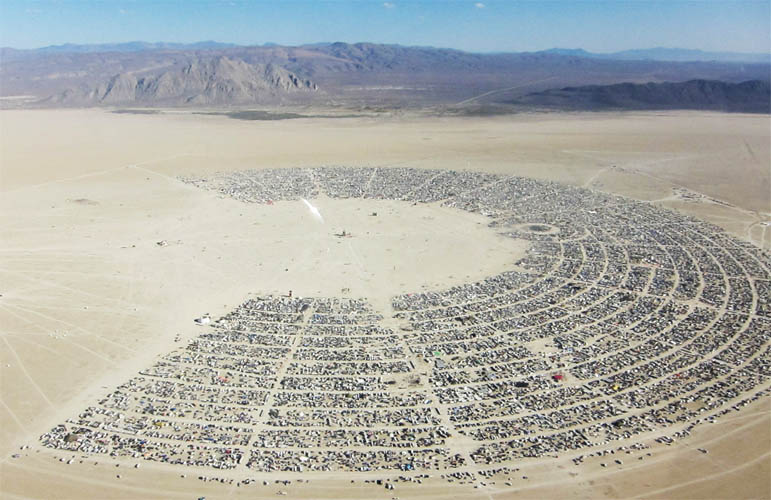
"What started out as a small event on San Francisco's Baker Beach and then migrated to
the Black Rock Desert has now morphed into a vibrant global year-round culture of
like-minded individuals who seek to live their lives in a more meaningful, powerful and
self-expressed way."

"Burning Man is an annual event and a thriving year-round culture.
The event takes place the week leading up to and including Labor Day,
in Nevah's Black Rock Desert. The Burning Man organization (Black Rock City LLC)
creates the infrastructure of Black Rock City, wherein attendees (or "participants")
dedicate themselves to the spirit of community, art, self-expression, and self-reliance."

"They depart one week later, leaving no trace. As simple as this may seem, trying to
explain what Burning Man is to someone who has never been to the event is a bit like
trying to explain what a particular color looks like to someone who is blind."
http://www.burningman.com

http://en.wikipedia.org/wiki/Burning_Man

Karma is not finite so make it happy! Polyamory, Paradoxical relationship

Karma is not finite so make it happy! Polyamory: Not a zero-sum game: Loving one person does not mean you have less love left for another. P...