This is something that is showing more in what I see in small towns the bottom
of the bottom getting desperate. Crime from the poor is jumping more than ever.
In my town the slums are really getting bad. The poor side of town 61% of the
town has always been like Detroit but it really is getting like it, for real!
This is a red flag I am holding up here!
The poor is going MadMax! And the middle Class is getting pulled down with them.
It's a big divide going from poor to the 001% from that I do see the MadMax life
popping up from the divide! More noted by the high up Walmart.
And to note, why I do what I do for the workers! http://walmart1percent.org
Give it's also stupid Republicans with their businesses make jobs thinking.
Like you can have a business with no one walking in the store to buy stuff to
give the store owners money so they can pay their workers.
The pay is too low to consume anything! As like me, being me I plan to
unplug my refrigerator being there is really nothing in there anyway.
It helps to offset a bit for using the heater in the winter.
I'm ok with that, it's changing times!
And that is why crime also goes up to get money to live or to go to
jail where you get food and heat in the winter vs how they are living.
Basic Sociology!
~~~~~The middle class no longer dominates in the U.S.
Middle class Americans now compriseless than half, or 49.9%,of
the nation's
population, down from 61% in 1971, according to a new Pew
Research Center
report. For Pew, middle class Americans live in
households earning between
two-thirds to two times the nation's median
income. In 2014, that ranged from
$41,900 to $125,600 for a three-person
household.
For decades, the middle class had been the core of the country.
A
healthy middle class kept America strong, experts and politicians said.
But more recently, these residents have struggled under stagnating
wages and
soaring costs. Presidential candidates on both sides of the
political aisle are
campaigning on ways to bolster the nation's middle class and increase opportunities
to climb the economic ladder.
The steady decline of the middle class is yet another sign of
economic polarization,
said Rakesh Kochhar, associate director of
research at Pew. Not only are more
Americans shifting into the upper and
lower classes, but they are moving into the
higher range of the upper
class and the lower range of the lower class.
This is yet another sign of growing income inequality, he said.
"There are fewer opportunities that place people in the middle of the income distribution,"
Kochhar said. One silver lining, however, is that more people are moving up the
ladder than down. The ranks of the upper class are growing faster,
according to Pew's research.
Senior citizens were most likely
to have shifted into the upper class since 1971.
The share of Americans
age 65 and over in the upper bracket increased nearly 27%
over that
time. Married couples with no children and black Americans also saw
larger gains.
Those most likely to fall into the lower class
were those with only a high school degree
and high school dropouts, as
well as unmarried men.
Here's another sign of how growing income inequality is squeezing the middle class.
Since 1970, upper class households saw their median income
soar 47% to $174,600 in
2014. Meanwhile, the middle class only got a
34% boost to $73,400. Still, they have been
more prosperous than the
lower-income Americans, who only received a 28% bump
to $24,074.
Some research shows that increased income inequality and a hollowing
out of a nation's
middle class stunts economic growth, Kochhar said.
Looking at it another way, the upper class now controls 49% of the nation's aggregate
income, up from 29% in 1970.
The middle class used to earn the largest slice ofthe nation's income. It held 62% in 1970,
but that share has since fallen to 43%.
The lower class, meanwhile, holds 9% of the country's income, just under the 10% it
earned in 1970.
The rich are not only trumping the middle class in terms of income.
They've also seen their
wealth soar over the past 40 years.
The median net worth of upper class families doubled between 1983 and 2013, up
to $650,100. But the wealth of the middle class has increased a near negligible 2%
over that time to $98,100. At least they fared better than lower-income
Americans,
who saw their wealth drop 18% to $9,500.
If you work at Walmart and you have any trouble / issues not being resolved
please contact the NLRB and let them know what is going on at the Walmart
you work at. Walmart is too damn big to play games at work.
As a worker you need to take care of yourself they won't take care of you!
If your hours are being cut please contact the NLRB in DC, not
the one in your state! Because of how big Walmart is!
And let them know whats going on!
Walmart makes too much money to cut your hours. Please stand up for yourself! These are times where you need no cuts! https://www.nlrb.gov Phone 1-866-667-NLRB
~~~~~Wal-Mart worker fired after 18 years for turning in $350 cash found in
Niskayuna store parking lot too slowly
Michael Walsh of Schenectady, a Wal-Mart
maintenance worker for 18 years,
was fired on Nov. 6, a few days after
he turned in $350 in cash he found in the
parking lot of the Wal-Mart
Neighborhood Market.
He was called into a manager's office, interrogated and terminated for
"gross misconduct."His offense? He waited about 30 minutes before he
turned in the money.
"The
only thing I did wrong was hesitate," Walsh said, who is 45.
"I didn't
steal anything. They didn't give me any warning. They just fired me."
The firing happened on the same day that Thomas Smith,
52, of Albany, an
East Greenbush Wal-Mart employee, was fired for
redeeming $2 worth of cans
and bottles left behind in a shopping cart.
Worker
rights advocates are organizing a Wal-Mart boycott through Jan. 1 and
additional East Greenbush store demonstrations in response to Smith's
controversial termination.
In the Niskayuna incident, a manager at
the store, located on State Street in
Mansion Square, said Tuesday she
could not discuss Walsh's firing. A
Wal-Mart spokesman, Aaron Mullins, said he had no comment.
Walsh
said he found a $5 bill in the parking lot and immediately went inside
and
turned it over to a manager. When he went back outside his job
involved picking
up garbage and collecting stray shopping carts he
found a small stack of bills,
$20s and $10s, in the parking lot. It was
not in an envelope and bore no identification.
He completed his task and when he got a moment, he counted the cash:
$350.
He stuffed it in his pants pocket. He went back inside the store,
which is adjacent
to a Berkshire Bank branch, and was about to turn in the bundle when he heard
a commotion.
"A
woman was yelling at a manager, freaking out that she lost her money
and
I got nervous," said Walsh, who speaks haltingly and has anxiety
issues.
"I kind of froze and didn't want any trouble."
Walsh
returned to his job, which included cleaning the bathrooms,
and he gave a manager the $350 in cash about 30 minutes after he found it.
The
manager took the money and Walsh heard nothing more.
Two days
later, a manager showed him a surveillance tape that was time-stamped
and confirmed that roughly 30 minutes elapsed from the time a camera
captured
Walsh's discovery of the cash and when he turned it in.
"They
didn't let me explain and said they knew what happened.
They told me
how it happened in a way they wanted it to go," Walsh said.
He was told
to sign a statement, but was not given a copy. He was told to turn in
his
badge and his employee 10 percent discount card.
He was fired for
"gross misconduct."
Walsh, who has a general equivalency diploma from Mont Pleasant High School
in
Schenectady, worked at the Glenville Wal-Mart for 10 years and other
Wal-Mart stores
in the area before being shifted to the Niskayuna
store. It's one-quarter the size of a
standard Wal-Mart Supercenter and
includes a grocery, pharmacy, deli and bakery.
"I enjoyed my job, I was a good employee and always got to work on time," he said.
"I got treated like a common criminal."
In
all his years as a Wal-Mart worker, including computer-based training,
Walsh said he never received a handbook of employee rules or company
policy about
items found in the parking lot.
Walsh got a raise in
September to $14.35 an hour, near a $15 cap for a maintenance
worker. He
was a full-time employee who worked 40 hours per week.
The timing
of his firing also upset Walsh because he lost out on his 20 percent
employee
holiday discount and fell short of a coveted 10 percent
lifetime discount card for
20-year employees.
"I was really looking forward to that lifetime discount card in two more years.
They took that from me," Walsh said.
Without
a paycheck, he is struggling to pay his $680 monthly rent and car
payment.
His wife is on disability for anxiety and depression.
"I
got scared and didn't go about returning the money in the right way," he
said.
"I told them I was sorry. I thought they would have given me a
warning or suspended me.
Instead, they just fired me."
But yet the cutbacks being "a small fraction of it's stores" you need to note
Walmart will take losses to make a sale! Many small businesses can't do what
Walmart does so they go away. Thus the issue with Sprawl http://sprawl-busters.com If Walmart takes a hit with the prices being over all, would be a massive amount vs wages cuts, and noted why small stores could not keep up being the lack of ability match Walmarts cuts in prices. Why is Walmart not taking a hit with wages being a small fraction? More workers working is more to the Revenue Per Employee value. That is $220,737 per employee revenue by the way!
If your hours are being cut please contact the NLRB in DC, not
the one in your state! Because of how big Walmart is!
And let them know whats going on and what I said up there.
Walmart makes too much money to cut your hours. Please stand up for yourself! These are times where you need no cuts! https://www.nlrb.gov Phone 1-866-667-NLRB
It's good that women stand up and get out. It's a pursuit of happiness valued as such!
Find those things that make you happy and grab them by the horns!
~~~~~The Grandma who went for a Walk Alone through 14 States
At the age of 67, Emma Rowena Gatewood told
her adult children she was going out
for a walk. Little did they know
that her “walk” would make her the first woman to hike
the
2,168-mile Appalachian Trail from Mount Oglethorpe in Georgia to Mount
Katahdin in
Maine solo, and in one season. She was a farmer’s wife from
Ohio, a mother to 11 children
who gave her 24 grandchildren, and a
survivor of domestic violence.
In 1950, Emma had read an article in the National Geographic about
the famous trail,
which she would later find out had greatly
exaggerated the ease of the hike, giving her
the impression of leisurely
walks and clean cabins at the end of each stretch. In 1955,
when she decided to embark on her little impromptu stroll, she wore Keds tennis
shoes and packed barely any hiking gear normally required except for a
blanket,
raincoat and a plastic shower curtain. As people began spotting the 67 year-old
grandmother making her way
alone through forests and wild lands on the longest
hiking-only trail in
the world,local newspapers picked up on the story.
Nicknamed “Grandma
Gatewood”, by the time she had reached Connecticut, Sports Illustrated had done an article on her and she became a celebrity before the
hike was even over.
There’s a tradition along the Appalachian Trail for some hikers to
receive “trail magic”,
assistance from strangers living along the
route in the form of anonymous kind actions,
gifts, food or places to
sleep. As Grandma Gatewood’s celebrity grew with every state
she
conquered, more strangers encouraged her with “trail magic”.
This remarkable farmer’s wife from Ohio had always found solace in
nature,
ever since her husband began physically beating her on a regular
basis just a few
weeks into their marriage. On more than one occasion,
he had nearly beaten her to death,
breaking her ribs and teeth,
threatening to have her committed to an insane asylum if she
tried to
leave him.
When she needed to escape their marital home, Emma often ran into the
woods to
find peace. Eventually, she was able to get a divorce, but
never re-married,
content in her solitude and confident she could take
care of herself.
When she completed her 14-state two thousand-mile hike, Mrs. Gatewood was
invited on the Today Show to
speak about her experience.
“For some fool reason, they always lead you
right up over the biggest rock to
the top of the biggest mountain they
can find”.
When asked for hiking tips, she said, “Make a rain cape, and an over
the shoulder sling
bag, and buy a sturdy pair of Keds tennis shoes. Stop
at local groceries and pick up
Vienna sausages… most everything else to
eat you can find beside the trail”.
*I would advise schools to jump in being a reasonable resource it will be!
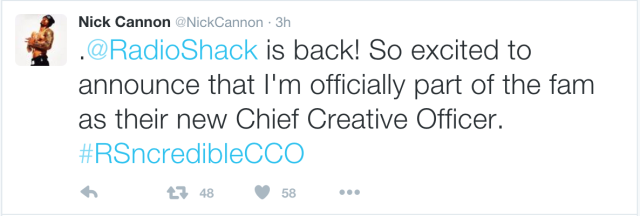
~~~~~RadioShack starts “wild ‘n out,” hires actor/rapper Nick Cannon as CCO
If you've seen actor, rapper, America's Got Talent host, and TeenNick chairman
Nick Cannon in the news lately, you might have assumed it was due to his performance
in an upcoming Spike Lee joint about violence in Chicago's south side.
But on Wednesday, the entertainer had news from an entirely different
dimension
when he announced that he had added another feather to his not-quite-Pharrell-sized hat:
chief creative officer at RadioShack.
Does this "hire" mean anything more than seeing Cannon's face on advertisements, as has been the case with many other major tech company celebrity hires? RadioShack certainly wants us to think so, as the company's announcement gave
a vague list of Cannon's CCO duties, the biggest of which appears to
be the "development of RadioShack-exclusive products." Cannon will also
be tasked with in-store music curation, event promotion, and helping the
company "continue to grow" its educational and STEM-specific
initiatives. RadioShack didn't specify what existing educational
initiatives it is running, and its home page currently offers no
official information about such initiatives. The announcement did recall a story from Cannon's youth, in which he
broke a stereo that he'd taken apart then went to a RadioShack in his
home of San Diego to get help fixing it where he eventually figured out
how to assemble and modify his own sound systems. (In other interviews,
Cannon has boasted that as a kid, he'd figured out how to connect
telephones to turntables and "make hold music.") "RadioShack is a brand that matters," Cannon said in the announcement. "As a kid, spending time in my neighborhood RadioShack was invaluable. The maker mentality and educational approach taught me a lot and
encouraged me to explore my own creativity. In return I wanted to give
back by fostering creative pursuits in others, and helping kids move to
the next level." However, while Cannon has launched tech ventures over the past few
years, the results have spoken less to RadioShack's maker mentality and
more to its modern, suffering incarnation, including budget-priced tablets sold on QVC and Beats-like headphones. Cannon previously served as an "entertainment ambassador"
for the annual Consumer Electronics Show, apparently to promote a line
of "Ncredible" tablets. Those devices included a built-in multimedia
sharing app designed to let aspiring entertainers pitch their acts
directly to Cannon's production company. (As of press time, the official Ncredible site's online store wouldn't load.)
Until today, the last major announcement
about the state of RadioShack
(after its filing for bankruptcy and
delisting from the NYSE earlier this year, that is)
came in July when
the company was acquired by General Wireless for $26.2 million.
With me I hope Luck, Fate, and Fortune will come knocking at my door. Oh please!
But in life you can only hope for the best and want the best for others.
Be supportive where you can and let them know your door is open!
~~~~~Fortuna & The Wheel of Fortune
In The Merchant of Venice, Portia, an affluent and
quick-witted heiress from
Belmont, aids in rescuing Antonio from his
legal plight with Shylock.
The fates of people around Portia shift
constantly, while her situation generally
improves without problem.
Portia’s actions through the play embody Fortuna’s
whimsical interest in
humanity.
In order to compare Portia and Fortuna, we need a little background
on
this mythical figure and her famous wheel. In Roman mythology,
Fortuna was the
goddess of Luck, Fate, and Fortune. She watched over the
fate of the individual as well
as the state. In her left hand, Fortuna
usually held a cornucopia,
a symbol of all
good things flowing in abundance. In the other hand,
Fortuna held a ship’s rudder,
which implied her power to steer the
delicate lives of mortals. By using both objects,
she was able to either
bring happiness to the person’s life, or completely destroy the
individual’s life instead.
Associated with Fortuna was her Rota Fortunae (Latin
for “wheel of fortune”), which
was a medieval concept that involved the
use of a wheel that a person symbolically rode
during his or her life.
At the top of the wheel, a person’s lifestyle was full of happiness
and
leisure. A individual at this level would live like a king. However, the
wheel would
eventually rotate and the person would begin to endure a
miserable existence, full of pain
and tragedy. Someone at the bottom
hoped that Fortuna would eventually spin her wheel
often enough for the
individual to come back on top, both metaphorically and financially.
Portia, true to her allegorical figure, jumps at the opportunity to
rescue Antonio
from Shylock during the trial scene, spotting it as a
situation where she can spin her
metaphorical wheel and dramatically
alter the fates of the people involved.
By indirectly offering to pay
more than triple the amount Bassiano borrowed from
Shylock, Portia’s act
symbolizes the cornucopia in Fortuna’s left hand.
The parallel between Portia and Fortuna also shows up in the last
scene of the play.
After revealing that she had been the lawyer during
the trial in Venice, Portia hands
Antonio a sealed letter:
“Unseal this letter soon; There you shall found three of your argosies,
Are richly come to harbor suddenly. You shall not know by what strange
accident,
I chanced on this letter.” (V.I.295-297)
Portia claims to have discovered the news herself without any external
help,
which leads me to see a further connection between her and the
concept of Fortuna.
Antonio, whose ships disappeared through fortune, is
finally rewarded with the return of
his ships after the terrible trial
with Shylock. Maybe Fortuna’s wheels rotated even
more for Antonio,
elevating him to an even higher level of wealth because his ships came
back to harbor. Like the rudder in Fortuna’s hands, Portia’s letter
embodies Fortuna’s
jurisdiction over a mortal’s life. https://sites.dartmouth.edu/exploratoryshakespeare/2015/07/14/fortuna-the-wheel-of-fortune
No matter who you are you have to accept it for the better of the good!
The way of life is a naturistic policy and if you just stand there you get ran over.
I talk about this a lot. If the wages goes up everything else will follow.
And the need for the pay to go up, mostly noted the fact that small towns
have nothing vs a bigger city. Basically noticed in the growth of Tulsa Oklahoma.
A place that has bumped up the pay vs a small town that keeps the
pay at their lowest. Small towns are in their way trying to grow to get around
not matching inflation as small towns wages are stagnant and so is the growth.
You can make it but can people afford it? Low wages keeps small towns down!
There is a such a divide rich and poor retail stores have to cater to both parties.
And that is depressing when you go into a store that does that being
it shows the divide in a bad light. My town is making a ALDI store for the rich
in town that don't want to go to Walmart to mingle with all the poor people!
There is too much hoopla to shop there and it's a way to screen out the poor
being they are too lazy to do it. In fact I say to the poor get in there and shop,
flood the place!
Also bad in a sociological view as the wages are low and life is low from that so
comes in the bottom of barrel workers. It's a fact of life you get what you pay for.
And where there is such a divide rich towns vs poor towns you get this more, it's
a fact of life and really should not be ignored! It shows the need to raise the pay to
keep it's ugly head from popping up. Such a divide causes the action of people
that want better pay being they like to buy food and pay their bills to work
at the better paying jobs. And will work at those places leaving the bad workers,
pushing the bad workers to lower income towns.
If you took a sociology class you might of learned
"There is a reason people work for the low pay, because they
can't make anywhere else." That normally a small issue but in a divide of richer
vs poorer things get massively worse! There is nothing bad with being a
bottom of the barrel, only that there would be so many in one spot
and if they expect you to live in the bottom of it also!
Pushing productivity (Productivity harassment!) is just harassing the workers being
the sales they want is just dust in the wind to the broke people that buys less.
And is like the do more with less of making your workers panic.
It's just shows a bad manager that failed and has to harass the workers to
get more done from the fail! Give the fail is also from the towns people being broke.
All of that points the wages do need to go up if you want anything in your town.
And... The fact many want nothing in town. Being they are sadomasochist voters.
Like it's noted in Oklahoma why people vote against their best interest.
Because they like it! And it does make others a victim from that practice,
like a nice car in the Walmart parking lot with a note stuck on it
"Sorry my bad!" Or like being in the quick sand with people that want to go down
in it with a few that want to do better. They can't they are in quick sand!
Well small towns are hell. Live in a small town welcome to hell!
It helps to understand this so you kind of know whats going on!
The point is all of this hell would be covered up with better pay.
It's just the wages are not matching inflation and the bottom of the iceberg
is exposed more than it should be! Better pay makes better people.
Progress runs over the sadomasochist voters that like it bad.
America can't live like they do. I mean if they did all we would have
in America would be a corn field. How bright would that light be?
Like in history we would be invaded easy. By Canada I hope!
Or noted as it's sad to be a victim of natural selection to roll with
the slow progress of it. As I see in my town people letting their homes rot.
In the end the house will fall over or they have to get out of the black mold trap.
There are more homes falling apart than they are tearing down in my town,
I noticed it lately. Nature is taking back it's land with no effort to stop it.
If they had better pay they could afford to fix their homes!
Anyway you see it the pay does need to go up in small towns.
All you really have to look at the growth in Tulsa from the better pay
to see the difference. If you are a sadomasochist and like it bad
then you make it bad for everyone else. Also it gives the town the bottom
of the barrel more than it should! With no change it's going to get worse in
small towns.
Many of the poor are "heavily in debt." in their car payment they had the last
10 years from refinancing the loan skipping payments.
Many just voluntary repossess the car to get rid of it not caring about
their credit history as it takes money to have credit, you have to buy stuff!
And many have their paycheck garnished, pay alimony leaving them to live
on half their paycheck. In that makes work places not willing to hire them
being they might steal at the work place because they would be hungry
and living on $4.50 after taxes etc. Garnishment & Alimony is a called a debt.
That is what workplaces look at to not hire people. What risk are they to the store. http://money.cnn.com/2015/12/01/news/economy/america-poor-in-debt/index.html
And I hope it shows the need to raise the pay for the better of the good!
~~~~~Minimum Wage Mythbusters Dol.gov Myth: Raising the minimum wage will only benefit teens. Not true: The typical minimum
wage worker is not a high school student earning weekend pocket money.
In fact, 89 percent of those who would benefit from a federal minimum
wage increase to $12 per hour are age 20 or older, and 56 percent are
women.
Myth: Increasing the minimum wage will cause people to lose their jobs. Not true: In a letter
to President Obama and congressional leaders urging a minimum wage
increase, more than 600 economists, including 7 Nobel Prize winners
wrote, "In recent years there have been important developments in the
academic literature on the effect of increases in the minimum wage on
employment, with the weight of evidence now showing that increases in
the minimum wage have had little or no negative effect on the employment
of minimum-wage workers, even during times of weakness in the labor
market. Research suggests that a minimum-wage increase could have a
small stimulative effect on the economy as low-wage workers spend their
additional earnings, raising demand and job growth, and providing some
help on the jobs front."
Myth: Small business owners can't afford to pay their workers more, and therefore don't support an increase in the minimum wage. Not true: A July 2015 survey
found that 3 out of 5 small business owners with employees support a
gradual increase in the minimum wage to $12. The survey reports that
small business owners say an increase "would immediately put more money
in the pocket of low-wage workers who will then spend the money on
things like housing, food, and gas. This boost in demand for goods and
services will help stimulate the economy and help create
opportunities."
Myth: Raising the federal tipped minimum wage ($2.13 per hour since 1991) would hurt restaurants. Not true: In California,
employers are required to pay servers the full minimum wage of $9 per
hour — before tips. Even with a 2014 increase in the minimum wage, the National Restaurant Association projects California restaurant sales will outpace all but only a handful of states in 2015.
Myth: Raising the federal tipped minimum wage ($2.13 per hour since 1991) would lead to restaurant job losses. Not true: As of May 2015,
employers in San Francisco must pay tipped workers the full minimum
wage of $12.25 per hour — before tips. Yet, the San Francisco leisure
and hospitality industry, which includes full-service restaurants, has
experienced positive job growth this year, including following the most recent minimum wage increase.
Myth: Raising the federal minimum
wage won't benefit workers in states where the hourly minimum rate is
already higher than the federal minimum. Not true: While 29 states and the
District of Columbia currently have a minimum wage higher than the
federal minimum, increasing the federal minimum wage will boost the
earnings for nearly 38 million low-wage workers nationwide. That
includes workers in those states already earning above the current
federal minimum. Raising the federal minimum wage is an important part
of strengthening the economy. A raise for minimum wage earners will put
more money in more families' pockets, which will be spent on goods and
services, stimulating economic growth locally and nationally.
Myth: Younger workers don't have to be paid the minimum wage. Not true: While there are some
exceptions, employers are generally required to pay at least the
federal minimum wage. Exceptions allowed include a minimum wage of
$4.25 per hour for young workers under the age of 20, but only during
their first 90 consecutive calendar days of employment with an
employer, and as long as their work does not displace other workers.
After 90 consecutive days of employment or the employee reaches 20
years of age, whichever comes first, the employee must receive the
current federal minimum wage or the state minimum wage, whichever is
higher. There are programs requiring federal certification that allow
for payment of less than the full federal minimum wage, but those
programs are not limited to the employment of young workers.
Myth: Restaurant servers don't need to be paid the minimum wage since they receive tips. Not true: An employer can pay a
tipped employee as little as $2.13 per hour in direct wages, but only
if that amount plus tips equal at least the federal minimum wage and
the worker retains all tips and customarily and regularly receives more
than $30 a month in tips. Often, an employee's tips combined with the
employer's direct wages of at least $2.13 an hour do not equal the
federal minimum hourly wage. When that occurs, the employer must make
up the difference. Some states have minimum wage laws specific to
tipped employees. When an employee is subject to both the federal and
state wage laws, he or she is entitled to the provisions of each law
which provides the greater benefits.
Myth: Increasing the minimum wage is bad for businesses. Not true: Academic research has
shown that higher wages sharply reduce employee turnover which can
reduce employment and training costs.
Myth: Increasing the minimum wage is bad for the economy. Not true: Since 1938, the federal
minimum wage has been increased 22 times. For more than 75 years, real
GDP per capita has steadily increased, even when the minimum wage has
been raised.
Myth: The federal minimum wage goes up automatically as prices increase. Not true: While some states have
enacted rules in recent years triggering automatic increases in their
minimum wages to help them keep up with inflation, the federal minimum
wage does not operate in the same manner. An increase in the federal
minimum wage requires approval by Congress and the president. However,
in his call to gradually increase the current federal minimum,
President Obama has also called for it to adjust automatically with
inflation. Eliminating the requirement of formal congressional action
would likely reduce the amount of time between increases, and better
help low-income families keep up with rising prices.
Myth: The federal minimum wage is higher today than it was when President Reagan took office. Not true: While the federal
minimum wage was only $3.35 per hour in 1981 and is currently $7.25 per
hour in real dollars, when adjusted for inflation, the current federal
minimum wage would need to be more than $8 per hour to equal its
buying power of the early 1980s and more nearly $11 per hour to equal
its buying power of the late 1960s. That's why President Obama is
urging Congress to increase the federal minimum wage and give low-wage
workers a much-needed boost.
Myth: Increasing the minimum wage lacks public support. Not true: Raising the federal
minimum wage is an issue with broad popular support. Polls conducted
since February 2013 when President Obama first called on Congress to
increase the minimum wage have consistently shown that an overwhelming
majority of Americans support an increase.
Myth: Increasing the minimum wage
will result in job losses for newly hired and unskilled workers in what
some call a “last-one-hired-equals-first-one-fired” scenario.
Not true: Minimum wage
increases have little to no negative effect on employment as shown in
independent studies from economists across the country. Academic
research also has shown that higher wages sharply reduce employee
turnover which can reduce employment and training costs.
Myth: The minimum wage stays the same if Congress doesn't change it. Not true: Congress sets the
minimum wage, but it doesn't keep pace with inflation. Because the cost
of living is always rising, the value of a new minimum wage begins to
fall from the moment it is set.