
DuGBuGoffice - WalmartRamen
Sunday, July 16, 2017
Something special
If you love life, love it's worth the effort to talk openly!
To accept what makes you who you are, to be fully there.
Let out that inner gypsy because you have a safety net
for your best interest because you would be their best interest
because if it's love it is!
Well you have to be open. Time is wasting, wasting not saying it!
Life is short enough! Work something out! Talk...
To have that conversation is gold! Otherwise is just a panic to deal with it.
Letting you know that you are something special!
If you have that feeling, say it, stop the regret!
~~~~~Accepting people does not itself mean agreeing with them, approving of them, waiving your own rights, or downplaying their impact upon you. You can still take appropriate actions to protect or support yourself or others. Or you can simply let people be. Either way, you accept the reality of the other person. You may not like it, you may not prefer it, you may feel sad or angry about it, but at a deeper level, you are at peace with it. That alone is a blessing. And sometimes, your shift to acceptance can help things get better.
How?
Pick someone who is important to you. (You can do this practice with multiple people.) In your mind, out loud, or in writing, say things like these and see how you feel: "I accept you completely. Countless causes, large and small, have led you to think, speak, and act the way you do. You are who you are. I let it be. You are a fact and I accept the facts in my life. You and I are part of a larger whole that is what it is, and I accept it, too."
If you like, be more specific, naming aspects of this person that particularly bother you, such as: "I accept that you . . . snore . . . leave your clothes on the floor . . . are still angry with me . . . have little natural interest in sex . . . are fighting me tooth-and-nail in this divorce . . . don't really understand me . . . are not a good teacher for my child . . . break the law . . . hurt people on a large scale . . . " (And remember that you can still disagree with, make requests of, or stand up to other people - while accepting them fully.)
See if you can tolerate what comes up for you when you soften into acceptance. Often we avoid accepting other people as a way to avoid the feelings we'd have if we opened wide to everything they are and everything they're not.
Consider how you have gotten tangled up with this other person, struggling to change them. When I do this myself, I become aware of my own rightness, positionality, judgments, pushiness, irritability, narrow views, hurts, longings, grievances, or remorse. See if you can let go of some, even all of these entanglements. Open to the easing, relief, and peace that can come when you do.
Also consider how much you like it when you feel that another person accepts you completely. It's a beautiful gift - and we can give it ourselves to others when we accept them. Imagine how it might improve your relationship with someone if that person felt you accepted him or her fully. Acceptance is a gift that gives back.
https://www.psychologytoday.com/blog/your-wise-brain/201410/accept-them-they-are
https://www.youtube.com/playlist?list=PLceEzjybohu4fFtCLWMETYvLLQwGwsGdD

Trip Hop
~~~~~What IS trip-hop?
While it would not be correct to assume that all triphop lyrics focus on anything in particular, a good deal of groups express sentiments on love, the loss of love, relationships in general, life in general, city life, escapism, etc. Not all, but a good deal of groups also approach these topics from a somber or regretful standpoint. This isn't to say that all triphop is for heartbroken souls who want to stay couped up in a studio apartment, chainsmoking and drinking all night because they are now damaged. There is triphop which deals with the good things in life as well: good times in life, worthy experiences, the pleasure of a certain herb, etc... but just about every triphop album out there will have at least a song or two that will focus on the downfalls of love. It seems to be quite a universal theme within this music. Hopefully this is starting to shape up into something that can actually be grasped.
http://oustedproductions.net/triphop/what.htm
Income a crucial role in determining a child's prospects

why do they do such actions. Or even not asking why!
It's like to say that crime is getting too high we need to make
more prisons, but not asking why are they doing the crime?
more prisons, but not asking why are they doing the crime?
With the light of that, you see the point to ask why!
My town I live in has been the child abuse capital
of Oklahoma for a long time. Mostly from child neglect
and that is a sign of low wages. Relating as many people
and that is a sign of low wages. Relating as many people
that let their kids run around. And that is from the job
the parents have. My ex girlfriend I had at the time
had kids in high school. We worked overnight at Walmart
so we went to bed 11 am and woke up around 10 pm.
So her kids where on the loose as we where sleeping.
so we went to bed 11 am and woke up around 10 pm.
So her kids where on the loose as we where sleeping.
Missouri aka "misery" many have locked up their kids in
a child safe room with a pad lock on the door for 4 hours
checking on the kid during lunch going back to work after.
It's common in Missouri. My EX girlfriends kid did that
but he also got caught with the 14 year old babysitter
by his wife. Her kid was locked up in a room,
as my ex girlfriends son and the babysitter...
as my ex girlfriends son and the babysitter...
The wife knew about her kid being locked up
as they did that a lot not being able to afford babysitters.
as they did that a lot not being able to afford babysitters.
What are they to do? They make low pay! The low pay life!
Why do they do those things? Lack of income,
no foundation to act normal. Who can afford to act normal anyway?
Reflecting the low income fixes many do, even me!
Why do people put a homemade coil cooler, or a fan
on a PC? Because they live with no AC on it's 90 degree
in their home and the PC overheats!
I asked and found out!
I asked and found out!
All of this is a point of low pay is a low labor force.
For adults walking with no cars to work is bad for productivity
as they burnout just going to work having a heat stroke in the
100 degree temperatures. People walk everywhere, and those
adults also have kids. They are tagged along because of the
lifestyle of low pay... Low everything, they are low also!
So for kids being low in these days is not a good thing.
In the 1940's you could work yourself up to better pay.
But in small towns and bigger towns you work hard and make
the same pay. Anything the same makes no growth!
So this points to a need to raise the pay because you get what you pay for!
~~~~~Household income plays crucial role in determining a child's prospects – report
The importance of money in determining a child’s life prospects is highlighted in a major new study published today – with household income found to have a significant impact on everything from children’s cognitive and educational outcomes to their social development and physical health.
“We can now confidently say that money itself matters and needs to be taken into account if we want to improve children’s outcomes,” says the review’s co-author, Kerris Cooper. “We often focus on gaps at school – but what the evidence shows is that money doesn’t only make a difference to children’s cognitive outcomes, it also makes a difference to their physical health, to birth weight, and to social and behavioural development.”
Fifty-five of 61 studies carried out in eight countries over the past three decades showed increases in income to have a positive effect across a variety of measures, according to the systematic review carried out by Cooper and Kitty Stewart of the Centre for Analysis of Social Exclusion at the London School of Economics.
The strongest evidence points to causal relationship between income and cognitive gains: an increase of US$1,000 in the year 2000 (roughly £860 in today’s currency) is associated with an improvement of between 5 and 27% in the “standard deviation” – meaning 5 to 27% of the gap between a poor and an average child would be closed if the former’s family had its income increased by this amount.
One US study, based on a randomized control trial and published last year, also shows how increased income reduces the likelihood of abuse or neglect.
While some of the effects seem modest in size – the measurable effects in the most recent studies, all of which were carried out in OECD or EU countries, ranged from 1 to 15% – researchers and campaigners say the significance of findings based on so much high-quality evidence, about so many millions of people, cannot be overestimated.
Alison Garnham, chief executive of Child Poverty Action Group, says the findings are a “hugely inconvenient truth for a government committed to implementing benefit cuts that are expected to tip more families into poverty and make already-poor families significantly worse off”. She adds: “When hard-up families have more money coming in, we know the extra is spent on fruit, vegetables, books, clothes and toys.”
The research, funded by the Joseph Rowntree Foundation, builds on a 2013 review with data from 27 studies published over the past five years, including four British ones. The study also looked at intermediate outcomes – that is, factors known to have a knock-on effect on children’s progress – and in the case of maternal mental health, found some of the strongest evidence that a lack of money has adverse effects.
We can now confidently say money matters and needs to be taken into account if we want to improve children’s outcomes.
Significantly, the measurable impact of increasing a family’s income is similar in size to the measurable impact of investment in education – suggesting that attempts to boost poorer children’s attainment at school, for example via the pupil premium paid to schools educating the poorest children, or subsidised early years education and nursery places – may be misdirected, if at the same time family incomes are falling.
Closing the income gap between the households of children entitled to free school meals and average households, the researchers estimate, might be expected to reduce the achievement gap by more than half, while at the same time delivering other positive effects such as health benefits in the home.
While the correlation between a child’s deprivation and bad outcomes ranging from lower test scores to physical abuse has been widely recognised for decades – Child Poverty Action Group was set up in 1965, and reducing child poverty was one of the pillars of New Labour social policy – the growing body of scientific evidence showing a causal relationship between financial income and children’s outcomes is highly significant in policy terms.
Child poverty in the UK has increased sharply since 2013 following benefit cuts, and the Institute for Fiscal Studies forecasts a further 50% increase in relative child poverty between 2014/15 and 2020/21. Last month, the social mobility commission chaired by former health secretary Alan Milburn delivered its report on two decades of government efforts to increase social mobility, and concluded that they have not worked. While early years and schools policies were found to have been more successful than those aimed at youth and employment, the report said it would take 40 years to close the gap between poor five-year-olds and their better-off peers.
Now campaigners believe the changed economic position, combined with new evidence from social scientists and neuroscientists investigating the impact of poverty on the development of young children’s brains, should prompt a rethink, particularly since there is little evidence that unemployment itself affects child outcomes, while some evidence on parenting interventions is mixed.
“I don’t think we can say that parenting classes and those kinds of investments aren’t important,” says Cooper, “but what we can say is that the economic context in which parenting takes place cannot be ignored. You are only going to get so far by focusing on parenting classes if you don’t address income poverty at the same time.”
Cooper’s own research on parenting finds mixed results, with some evidence showing that poorer parents help children more with maths and writing, but score “worse” when it comes to the number of outings and trips, and the amount of time children spend watching television or playing on computers.
Labour MP Frank Field is one of those associated with the shift away from poverty reduction measures and towards “non-financial elements”. Commissioned by then-prime minister David Cameron in 2010 to produce a report aimed at refocusing government efforts on behalf of poor children away from income transfers, Field recommended a new set of “life chances indicators” and argued that their experiences of the first five years of life “matter more to children than money”.
Seven years on, he stands by his report’s finding that factors including maternal mental health and home learning environment trumped income and class in determining how ready children are for school. But he points out this research was done in 2010 “when families were doing massively better” – before the full impact of the recession was felt, and before the “mega mega mega cuts” to benefits that have seen families’ income decline “to the extent that we are seeing the emergence of destitution”. Today, Field believes reversing these cuts should be Labour’s priority.
The newly appointed children’s minister Robert Goodwill, when asked whether insufficient attention had been paid to the impact on children of income itself, referred instead to the government’s record on getting parents into work. “Work and education are the best routes out of poverty,” he said. “Employment levels are at a record high, and there are 590,000 fewer children in workless families compared with 2010.”
Goodwill added that the attainment gap between better- and worse-off pupils is narrowing, and highlighted the continuation of the pupil premium, alongside investment in 12 of what the government calls “social mobility coldspots”.
Alternative explanations for unequal outcomes, such as genetic differences, have not gone away. Though they are sometimes shy about saying so in such bald terms, some defenders of a highly stratified system – in which inequality itself is not seen as a problem, so long as mechanisms exist to enable some of those who start at the bottom to rise to the top – continue to believe that richer people as a rule are cleverer and more deserving of success. An echo of this view can be heard in Theresa May’s “great meritocracy” speech last year, in which she described meritocracy as a way of assisting “the brightest among the poor”, and repeatedly distinguished “talent” from “hard work”.
“It’s all connected up,” says Cooper. “The implication that workless parents with less education parent differently … is part of the same idea that poor people themselves are to blame for their children’s outcomes, not the structural and economic conditions of poverty.”
It seems unlikely that policy-makers will heed the researchers’ call to look afresh at income inequality when considering childhood outcomes – and, crucially, to increase state benefits to the poorest families who, in the UK, have seen them removed. But should this government or another one seek a change of direction, there is now plenty of evidence to back them up.
https://www.theguardian.com/inequality/2017/jul/12/household-income-crucial-role-children-life-prospects-lse-report
~~~~~Who are America’s Poor Children?
Fourteen million American children live in families with incomes below the federal poverty level, which is $22,050 a year for a family of four. 1 The number of children living in poverty increased by 21 percent between 2000 and 2008. There are 2.5 million more children living in poverty today than in 2000.
Not only are these numbers troubling, the official poverty measure tells only part of the story. Research consistently shows that, on average, families need an income of about twice the federal poverty level to make ends meet. 2 3 Children living in families with incomes below this level – for 2009, $44,100 for a family of four – are referred to as low income. Forty-one percent of the nation’s children – more than 29 million in 2008 – live in low-income families.
Nonetheless, eligibility for many public benefits is based on the official poverty measure. This fact sheet – the first in a series focusing on economic and material hardship – details some of the characteristics of American children who are considered poor by the official standard.
http://www.nccp.org/publications/pub_912.html
~~~~~Negative childhood experiences have serious education consequences, experts say
One expert calls negative early childhood experiences the most important public health issue of our time.
Amanda Sheffield Morris, speaking last week in Oklahoma City, said bad experiences set the stage for academic struggles in school and possible substance abuse during the adolescent years.
Morris, foundation chair in child development at Oklahoma State University, was a breakout session speaker during the Oklahoma Early Childhood Coalition Summit, organized by the Potts Family Foundation. Also addressing the issue was Lana Beasley, associate professor of human development and family science at OSU.
Examples of an adverse childhood experience, or ACE, are abuse, neglect and witnessing domestic abuse or substance abuse by a parent. Divorce, parental incarceration and poverty are other factors the speakers said can hamper the life of children as they enter school.
"Oklahoma has one of the highest ACE rates in the nation," Morris said. Quoting Kaiser Foundation studies, she said 45.5 percent of Oklahoma children are "at risk," with three or more ACE's. She said Oklahoma has one of the highest divorce rates, and 11 percent of children have witnessed domestic violence.
The good news, Beasley said, is that something can be done to offset the problems caused by adverse childhood experiences.
"Good quality early childhood education can make a difference," she said.
Beasley cited work done on the Perry Preschool Project. The program, started in 1962 in Michigan, was offered to more than 100 disadvantaged children, and follow-up studies have been done over the past 50 years.
What was discovered, she said, is that project participants grew up to have fewer children out of wedlock, earned higher incomes and were less likely to receive government assistance.
"Communities and organizations have to come together to minimize ACE's," Morris said. Intervention and prevention at an early age pay dividends, she said.
Beasley said the return on investment ranges anywhere from 7 to 13 percent.
During a question-and-answer session, one participant wondered if money now spent on corrections could be diverted to early childhood education.
Both speakers said investments early in a child's life are cheaper solutions than incarceration later in life. They also encouraged mental health support for parents to prevent physical abuse as well as substance abuse, and advocated safe and affordable housing as well as investment in education.
"Our legislation and policies must focus on child safety," Beasley said. Beasley said her work with at-risk families has at times left her heartbroken as she hears from parents who are afraid to send their children to school with violent students. Some say they must drive to parks across town, because their neighborhood parks are not safe.
Morris said society needs to reshape its thinking toward students who struggle in school with academic and behavioral issues.
"Instead of asking them 'what is wrong with you,' we need to ask
'what happened to you?'"
http://newsok.com/negative-childhood-experiences-have-serious-education-consequences-experts-say/article/5556348 - (*Note 48)
Income inequality is a factor if the foundation is low everything follows it.
I believe in the Common Core being you can't fix the kids test score unless
you know what is lacking.
I do not believe in high stakes testing in that you would only be
punishing the kids and holding the Teachers accountable to the towns income!
http://walmartramen.blogspot.com/2017/06/teacher-accountability-and-illiterate.html
Case in point, "The 20 ‘Worst’ Public Schools in America"
"1. East St. Louis Lincoln Middle School"
http://www.cheatsheet.com/money-career/the-20-worst-public-schools-in-america.html
~~~~~Who are America’s Poor Children?
Fourteen million American children live in families with incomes below the federal poverty level, which is $22,050 a year for a family of four. 1 The number of children living in poverty increased by 21 percent between 2000 and 2008. There are 2.5 million more children living in poverty today than in 2000.
Not only are these numbers troubling, the official poverty measure tells only part of the story. Research consistently shows that, on average, families need an income of about twice the federal poverty level to make ends meet. 2 3 Children living in families with incomes below this level – for 2009, $44,100 for a family of four – are referred to as low income. Forty-one percent of the nation’s children – more than 29 million in 2008 – live in low-income families.
Nonetheless, eligibility for many public benefits is based on the official poverty measure. This fact sheet – the first in a series focusing on economic and material hardship – details some of the characteristics of American children who are considered poor by the official standard.
http://www.nccp.org/publications/pub_912.html
~~~~~Negative childhood experiences have serious education consequences, experts say
One expert calls negative early childhood experiences the most important public health issue of our time.
Amanda Sheffield Morris, speaking last week in Oklahoma City, said bad experiences set the stage for academic struggles in school and possible substance abuse during the adolescent years.
Morris, foundation chair in child development at Oklahoma State University, was a breakout session speaker during the Oklahoma Early Childhood Coalition Summit, organized by the Potts Family Foundation. Also addressing the issue was Lana Beasley, associate professor of human development and family science at OSU.
Examples of an adverse childhood experience, or ACE, are abuse, neglect and witnessing domestic abuse or substance abuse by a parent. Divorce, parental incarceration and poverty are other factors the speakers said can hamper the life of children as they enter school.
"Oklahoma has one of the highest ACE rates in the nation," Morris said. Quoting Kaiser Foundation studies, she said 45.5 percent of Oklahoma children are "at risk," with three or more ACE's. She said Oklahoma has one of the highest divorce rates, and 11 percent of children have witnessed domestic violence.
The good news, Beasley said, is that something can be done to offset the problems caused by adverse childhood experiences.
"Good quality early childhood education can make a difference," she said.
Beasley cited work done on the Perry Preschool Project. The program, started in 1962 in Michigan, was offered to more than 100 disadvantaged children, and follow-up studies have been done over the past 50 years.
What was discovered, she said, is that project participants grew up to have fewer children out of wedlock, earned higher incomes and were less likely to receive government assistance.
"Communities and organizations have to come together to minimize ACE's," Morris said. Intervention and prevention at an early age pay dividends, she said.
Beasley said the return on investment ranges anywhere from 7 to 13 percent.
During a question-and-answer session, one participant wondered if money now spent on corrections could be diverted to early childhood education.
Both speakers said investments early in a child's life are cheaper solutions than incarceration later in life. They also encouraged mental health support for parents to prevent physical abuse as well as substance abuse, and advocated safe and affordable housing as well as investment in education.
"Our legislation and policies must focus on child safety," Beasley said. Beasley said her work with at-risk families has at times left her heartbroken as she hears from parents who are afraid to send their children to school with violent students. Some say they must drive to parks across town, because their neighborhood parks are not safe.
Morris said society needs to reshape its thinking toward students who struggle in school with academic and behavioral issues.
"Instead of asking them 'what is wrong with you,' we need to ask
'what happened to you?'"
http://newsok.com/negative-childhood-experiences-have-serious-education-consequences-experts-say/article/5556348 - (*Note 48)
Income inequality is a factor if the foundation is low everything follows it.
I believe in the Common Core being you can't fix the kids test score unless
you know what is lacking.
I do not believe in high stakes testing in that you would only be
punishing the kids and holding the Teachers accountable to the towns income!
http://walmartramen.blogspot.com/2017/06/teacher-accountability-and-illiterate.html
Case in point, "The 20 ‘Worst’ Public Schools in America"
"1. East St. Louis Lincoln Middle School"
http://www.cheatsheet.com/money-career/the-20-worst-public-schools-in-america.html
Recurring Numbers and 48

Have you ever had a recurring number? I have...
My recurring number is, 48! I was driving home from Oklahoma City, and I
seen the sign that said it was 48 miles to Tulsa and it was 8:48.48 pm when I looked
at my watch. Many times I have looked at my watch and it was like 7:48 then the
next time I looked it was 8:48 on the minute. Had a friend at work that when I added
his phone number 4+5+... etc. It came to be 48! My initials put to numbers A,1 etc
is 4.8.! I will be 48 this year!
Also there was a lady at work in the 90's I loved she was born in 1948
and she was 48 when I fell for her! And at work that year my paycheck
kept popping up with the 48 number! Like my pay was $486.48 or my
social security tax had the 48 somewhere on it.
The 48 was bad that year all at once!
These days? It still pops up like in a webpage I might be looking at it will have the
48 number somewhere on it. On a website I use, my 48 number is on the https
on my address on the site. I had nothing to do with it. These things pop up!
So to me I see it as a marker. If I search on Youtube or any search for something
and the address has a 48 on it I will look at it!
I wanted to do this story but felt like it would freak people out but as it seems
the recurring number seems to be popping up again.
My old lady went to the store and bought a few things and paid separately,
cash and card. They where the same amount for different things.
And I have been seeing my 48 number pop up lately! So...
I did the story! I hope it is telling me for the best! I need the best!
"Angel Number 48 indicates that the ‘angels of abundance’ surround you and
are with you as you experience positive life changes.
They ask that you release any fears about your finances and trust that your
needs will be met."
I always ran like that about my finances! I might be broke but as always I ended
up making it. Something worked out, a bill would be less than I thought or
I would find a $20. So I do believe in that! Even found a $20 in my
jacket pocket I left in there to surprise myself the next time it got cold out
and I put my jacket on!
http://walmartramen.blogspot.com/2015/01/thanks-past-dude-you-gave-me-20.html
But the point is believe, love, and know there is hope. And there is a light
that points, warns you to look out a change is hitting you!
Hoping for the best change! I was driving with my EX wife once and we
saw a wolf on the side of the road. "Sensitivity about feelings of threat."
I was with my EX wife and was in the middle again of our on and off again
bounces with my Cherokee girlfriend... Threat! Ouch!
bounces with my Cherokee girlfriend... Threat! Ouch!
I still love both, I'M poly and responsible!
So...
~~~~~Ever notice that a certain number or sequence of numbers seems to pop
up
everywhere you look? When numbers recur and repeat in life, it's
Numerology's little way of alerting you to information you may be
missing,
an action you're not taking or a problem you may not be aware
of.
It's a cosmic heads up, forcing you to pay attention to the real
issue at hand.
~~~~~Number 48 is made up of a combination of the vibrations and attributes of number 4 and number 8. Number 4
brings the qualities of realistic values, truth and
honesty, determination and diligence, building strong foundations for
the self and others, achieving success, practicality and hard work.
Number 4 also relates to our passion and drive. The number 8 resonates with manifesting wealth and abundance, learning through experience, inner-strength and wisdom, self-reliance and dependability, and Karma – the Universal Spiritual Law of Cause and Effect and giving and receiving.
Angel Number 48 is a message from your angels that a cycle or phase will soon be coming to an end, with rewards coming from hard work well done. Do not fear lack or loss as these endings and conclusions will lead to auspicious new beginnings and opportunities, and your success and achievement will bring blessings and rewards of many kinds into your life.
Angel Number 48 indicates that the ‘angels of abundance’ surround you and are with you as you experience positive life changes. They ask that you release any fears about your finances and trust that your needs will be met.
Angel Number 48 is a message that the hard work and determination you have put towards living your life according to your personal truths has fully aligned you with your Divine life purpose and soul mission, and with this you will reap abundance and plenty to maintain and sustain you as you continue along your path. Trust that the angels are supporting, encouraging and guiding you.
Angel Number 48 is a message from your angels that a cycle or phase will soon be coming to an end, with rewards coming from hard work well done. Do not fear lack or loss as these endings and conclusions will lead to auspicious new beginnings and opportunities, and your success and achievement will bring blessings and rewards of many kinds into your life.
Angel Number 48 indicates that the ‘angels of abundance’ surround you and are with you as you experience positive life changes. They ask that you release any fears about your finances and trust that your needs will be met.
Angel Number 48 is a message that the hard work and determination you have put towards living your life according to your personal truths has fully aligned you with your Divine life purpose and soul mission, and with this you will reap abundance and plenty to maintain and sustain you as you continue along your path. Trust that the angels are supporting, encouraging and guiding you.
http://sacredscribesangelnumbers.blogspot.com/2011/07/angel-number-48.html
Also: http://www.sunsigns.org/angel-number-48-meaning
http://www.intuitivejournal.com/do-you-see-repeating-numbers
Also: http://www.sunsigns.org/angel-number-48-meaning
http://www.intuitivejournal.com/do-you-see-repeating-numbers
The prophecies of 48 Jewish prophets and 7 prophetesses were recorded in the
Tanakh for posterity. According to the Mishnah, Torah wisdom is acquired via 48
ways (Pirkei Avoth 6:6) Siddhartha Gautama, the founder of Buddhism, sat under a
bodhi tree for 48 days attempting to understand the nature of reality and Universe.
Buddhism was the result.
https://en.wikipedia.org/wiki/48_%28number%29
Saturday, July 15, 2017
Love Is Letting Go Of Fear
I always say I love with no boundaries. Life can be short!
In 1985 I got hit by a car doing 45 mph on my moped doing 0 mph!
What is life about? Too short to have false fears holding you back!
http://walmartramen.blogspot.com/2015/06/here-in-my-car.html
"Fear is the main source of superstition, and one of the
main sources of cruelty. To conquer fear is the beginning
of wisdom."
"The good life is one inspired by love and guided by knowledge.
Neither love without knowledge, nor knowledge without love
can produce a good life.” - Bertrand Russell
~~~~~How to Let Go of Fear and Return to Love
What is LOVE?
Whenever I ask myself this question, the answer that comes to mind is always the same:
“Love is who we are, it’s what we are all made of.”
But what does this mean?
It means that we are all made of love, made with love and made to love and whenever we are anything other than love we are not truly being ourselves. We move away from our true nature. And as a result, we start to build a false identity for ourselves, pretending to be something we are not and taking our sense of worth from outside of us and no longer from within ourselves.
That’s how the struggle begins. That’s how most of us start settling for way less than we are worth, constantly using the past as an excuse of why we can’t move forward in life, crafting sad, lonely, unhappy and mediocre lives.
Why do you think there’s so much violence in the world, people who live in poverty, couples who stay in unhealthy and toxic relationships, men and women do work that has no value and no meaning for them? Why do you think so many people live in fear, expecting the worst to always happen, talking more about their pains and sorrows than they talk about their joys and blessings? Because we have moved away from who we truly are, we have moved away from LOVE. And when you move away from love, you start to feel scared, disconnected, lost and lonely and life becomes a struggle.
“There are two basic motivating forces: fear and love. When we are afraid, we pull back from life. When we are in love, we open to all that life has to offer with passion, excitement, and acceptance. We need to learn to love ourselves first, in all our glory and our imperfections. If we cannot love ourselves, we cannot fully open to our ability to love others or our potential to create. Evolution and all hopes for a better world rest in the fearlessness and open-hearted vision of people who embrace life.” ~ John Lennon
You are made of love, made with love and made to love and whenever love is not present within your heart, you will feel disconnected from the world around you and you will feel as though something is missing from your life. And that something, that missing piece will be YOU – your awareness about who you truly are and what you are really capable of being, doing and having. The missing piece will be LOVE.
The return to LOVE
“It is good to feel lost… because it proves you have a navigational sense of where “Home” is. You know that a place that feels like being found exists. And maybe your current location isn’t that place but, Hallelujah, that unsettled, uneasy feeling of lost-ness just brought you closer to it.” ~ Erika Harris
No matter how long you have been wondering around, feeling lost, disoriented and confused, looking outside of you for all the things that you thought were missing from within you, if you want to get back to yourself if you want to return to LOVE, you can. For love always was and always will be, lovingly waiting for you.
Love never left you and will never do.
“I know you’re tired but come, this is the way.” ~ Rumi
So how do you let go of the past and return to LOVE? How do you go from living in fear to living in LOVE; from feeling lost to being found; from feeling scared, drained, exhausted and unhappy to feeling happy alive, refreshed and rejuvenated?
You return to LOVE by first setting an intention to do so. By making a promise to yourself to spend the rest of your life fully loving, nurturing and honoring who you are.
You return to LOVE by unlearning all that you have learned about yourself, about life and about LOVE and by living life from a place of infinite choices and possibilities – the present moment, no longer from a place of fear and limitations – the past.
You return to LOVE by forgiving everything and everyone, including yourself and by sending love to all those who might have hurt and harmed you at one point or another.
You return to LOVE by making peace with your darkness, your shadows, fears, and insecurities and by filling your heart with love, light, and trust. Trust in yourself, trust in love and trust in life itself.
You return to LOVE by accepting and embracing yourself just as you are right at this moment and by pouring unconditional love upon yourself, upon all that you do and all that you are.
You return to LOVE by realizing that in this moment you are ENOUGH.
You return to LOVE by taking the time to know yourself, to spoil yourself and to love yourself.
You return to LOVE, to yourself and your true nature by spending time outside in nature observing, admiring and contemplating at the beauty of life itself.
You return to LOVE by nurturing kind and loving thoughts about yourself and about the world around you. And by constantly thinking, talking and acting upon that which you want to experience and attract in your life.
You return to LOVE by becoming aware that you are ONE with all that is, ONE with the people you love but also those you dislike; ONE with the riches that you want to have in your life but also with the poverty that is present in the world; ONE with those who are kind but also with those who are unkind; ONE with the trees, the plants, the stars, the Moon and ONE with life itself.
You return to LOVE by surrendering to what is and by trusting that maybe everything in life is happening exactly the way it should be happening. And that maybe we all have some very valuable lessons to learn from both the good and bad experiences and people that come our way.
You return to LOVE by expressing your love, gratitude, and appreciation for everything that comes your way, every thought, every person, every interaction and by seeking to use them all to become a better not bitter person.
You return to LOVE by understanding that you are LOVE and that there is nothing about you lacking, there never was nor will there ever be.
You return to LOVE by understanding that you don’t have to do more of anything and you don’t have to acquire more stuff, have more friends and make more money in order for you to feel whole, worthy and complete.
You return to LOVE not by getting more, having more and doing more but by being more – being happy, content, peaceful, graceful, grateful and so on. That’s how you return to LOVE. That’s how you return to your beautiful and loving Self.
http://www.purposefairy.com/69789/how-to-let-go-of-fear-and-return-to-love
Low Pay, Low Water Use, Contaminants
How is your water in town? Small towns are small for a reason.
Make nothing have nothing! You know what happens to stale water
that just sits there not being used because many can't afford to use water.
Their water bill is $50+ before they use any!
that just sits there not being used because many can't afford to use water.
Their water bill is $50+ before they use any!
If there are many people walking with no cars not being able to
walk to the airport it's 50 miles to the airport so they can't build their frequent
flyer miles... They don't even have a car so do they use much water?
Disabled in society by their low wages effecting everything around them.
And the point of needing to fix it. If you walk with no car and can't
afford to use water being a $50 water bill, the pay needs to go up!
~~~~~Flint Ignored A Memo On How To Make Water Cheaper.
Now FLINT, MICHIGAN — Stephanie and Joseph Morales are upstanding members of the Unitarian Universalist church and the parents of nine young children. But they haven’t paid their water bills for nearly two years.
The Flint residents, whose children range from ages three to 17, stopped drinking their tap water pretty much immediately after the city switched the source from Detroit to the Flint River in April 2014, causing widespread contamination from lead and other chemicals. The taste was off, and there was a day when they drew a bath and all the water came out brown. “We noticed right away,” Joseph said.
That prompted them to start buying and using bottled water to drink and cook with. But it was a costly undertaking — they started shelling out somewhere between $50 and $100 a month to get enough for their family. “We tried making sure that we got it on sale whenever we could,” Stephanie said.
That extra cost came on top of the steep bills they were already paying for the tap water they couldn’t use — somewhere in the $120 to $140 range a month. So they stopped responding to the bills last summer. “I found it ridiculous to pay,” Joseph said. “I’m trying to find the money to buy bottled water… so you know what, I’m not going to pay my water bill. If they want to come and shut it off, okay, we’ll just deal with it.”Its Residents Are Paying The Price.
The Morales’s bills are about in line with an analysis from 2014 finding that residents pay $140 a month on average, far higher than other surrounding areas and about eight times higher than the national average.
Those rates were already a burden for many residents, leading many low-income families — Flint’s poverty rate is above 40 percent — to stop paying altogether and prompting lawsuits over shutoff notices. But now that people know the water was unsafe to drink going back potentially as far as spring of 2014, they’re wondering why they should have to keep paying such exorbitant bills for water they can’t even use.
That problem — nonpayment of water bills — will only serve to starve the city of the revenue it could very much use to help cover the enormous cost of ripping out the city’s entire water system, which many believe has been irreparably compromised, and replacing it with new pipes.
https://thinkprogress.org/flint-ignored-a-memo-on-how-to-make-water-cheaper-now-its-residents-are-paying-the-price-c1bc8c2b929?gi=3f4c6615ea3c
Water is bad and added to the bad if there is just no use!
http://www.mass.gov/eea/agencies/massdep/water/drinking/standards/haloacetic-acids-haa5.html
https://www.uc.edu/gissa/projects/drinkingwater/contaminant_list.html
http://www.cnn.com/2016/08/09/health/contaminated-water/index.html
There is a big issue with low pay to low water use, stagnating water.
Why is that? There are drought stricken places that use less water.
And how power plants are cooled now, they use less water.
The point is less water is being used from not being able to.
The low water use is shown more to be poor by the poor, showing how
poor we all really are! Take away the water use from businesses shows
the real use from the people. Poor people!
https://www.greenbiz.com/article/why-water-usage-declining-across-united-states-0
Thursday, July 13, 2017
Eels, Eels, Eels
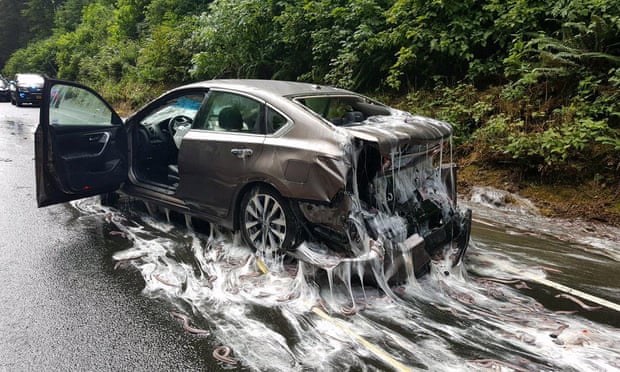
~~~~~Truck carrying eels overturns, dumping slime over cars and highway
An Oregon highway has been “slimed” after a truck carrying 3,400kg (7,500lb) of eels overturned, spilling the animals and their excretions all over the road and nearby vehicles.
The accident occurred on highway 101 just south of Depoe Bay in Oregon early on Thursday afternoon. No one was injured, according to police, but multiple cars were affected and one lane of the highway was closed while the cleanup took place.
According to the Oregonian and the fire department, the animals are not technically eels and are in fact Hagfish – prehistoric creatures with skulls but no jaw or spine, which produce slime through glands on their sides, especially when stressed. They are colloquially known as “slime eels”, for obvious reasons.
https://www.theguardian.com/us-news/2017/jul/14/truck-eels-overturns-slime-cars-highway
Subscribe to:
Posts (Atom)
Karma is not finite so make it happy! Polyamory, Paradoxical relationship
Karma is not finite so make it happy! Polyamory: Not a zero-sum game: Loving one person does not mean you have less love left for another. P...

-
As like a law of nature yes women look! And that is ok. Why? For many reasons to have value, love and belongingness. Too many guys at l...
-
Being how things on the internet is these days security is needed! When I worked on my version of K-Meleon db types browser it was for th...
-
 If you work at Walmart you know this but to the shoppers & everyone else. Here is some secret info about Walmart. For one their dat...

